The State of AI Adoption in UK Businesses

We hear a lot about AI's potential. What we hear less about is what's actually happening inside UK businesses right now which functions it's landed in, how adoption varies by size and sector, and where the hesitation still sits.
To answer those questions, Moneypenny surveyed 750 decision-makers across UK businesses between April and May 2025. Here's what the data tells us.
In this article
- Are UK businesses currently using AI?
- How are UK businesses using AI?
- Which business functions use AI the most?
- Does company size affect AI adoption?
- Which UK sectors are most advanced in AI?
- Which UK regions are embracing AI the most?
- What's next for UK businesses and AI?
- How can Moneypenny help?
Are UK businesses currently using AI?
Yes and the majority are either already using it or actively planning to. According to Moneypenny's research, 39% of UK businesses are using AI in some form today, with another 31% seriously considering it. That puts total interest at nearly 70%.
- 39% of UK businesses are currently using AI
- 31% are seriously considering AI adoption
- ~70% are either using or planning to use AI
AI adoption across the UK
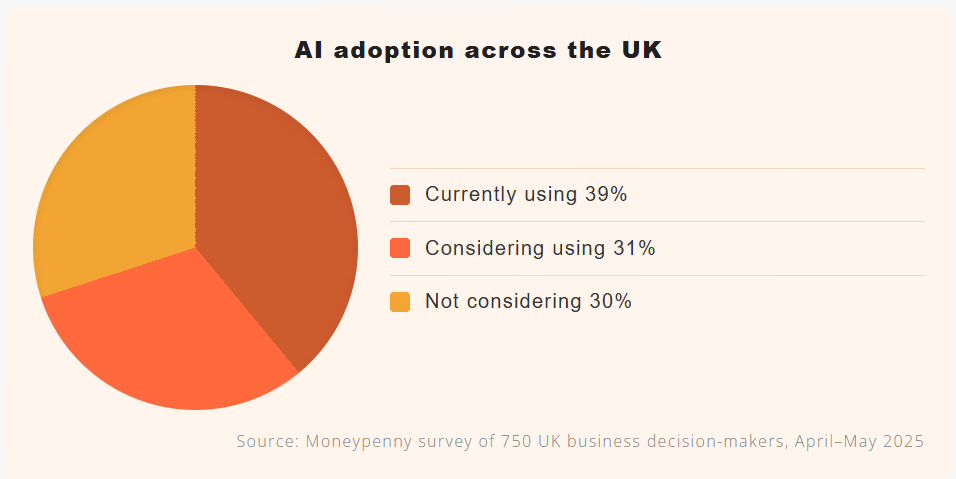
Only 30% say they're not considering AI at all right now. This near-even three-way split reflects a market in transition: most businesses are moving at different speeds but a sizeable third are still watching from the sidelines, whether due to budget, uncertainty, or suitability.
How are UK businesses using AI?
Most businesses aren't going all-in at once. The dominant pattern is selective adoption using AI in specific areas while continuing to evaluate where else it can add value.
- 40% are adopting AI selectively for specific use cases
- 28% are fully embracing AI across their organisation
- 12% have no plans to adopt AI at all
Stages of AI adoption in UK businesses
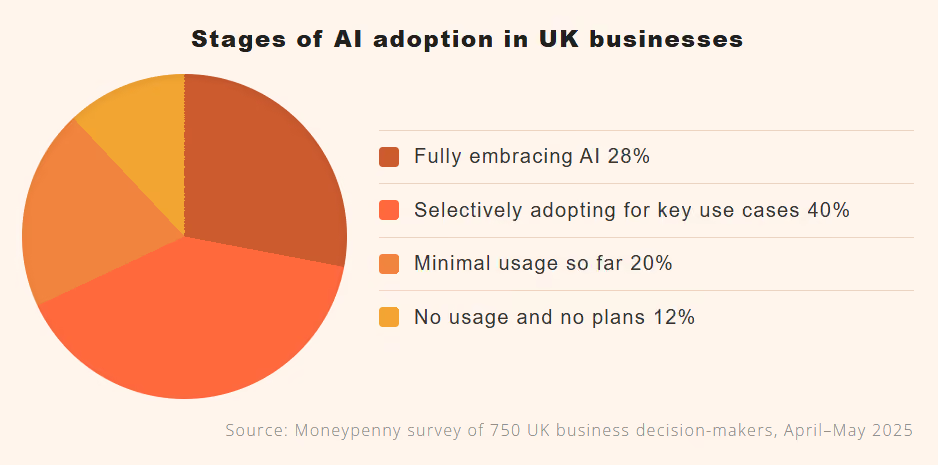
The pattern emerging across UK businesses: apply AI where it solves a clear problem, measure the result, then expand. Rather than rushing into full automation, businesses are focusing on where AI can genuinely support their people and improve the way they work. In many cases, that's proving to be the smartest route of all.
Which business functions use AI the most?
Analytics, customer support, and content creation lead current AI usage among UK businesses but the top five functions are closely clustered, all above 40%.
- 46% use AI for analytics and reporting the highest-adopted function
- 45% use AI for customer support and chatbots
- 34% use AI for telephone answering, with 33% still considering it
AI adoption by business function
What do these areas have in common? They're all about scale and speed places where AI can save hours, simplify decisions, or deliver quick wins. The most successful AI use cases support people rather than replace them. They work alongside your team, not instead of them.
Telephone answering sits slightly lower at 34%, with one in three businesses using AI to support call handling. That said, another third are still considering it suggesting we could see a steep rise in adoption here over the next year, particularly in sectors like property and professional services where call volume is high and every missed call has a direct cost.
Telephone answering is the function with the largest untapped pipeline: 34% currently using + 33% considering = two-thirds of UK businesses will likely be using AI for call handling within the next 12–18 months. Find out how Moneypenny's AI Receptionist works.
Does company size affect AI adoption?
Yes but it's not just about scale. It's about access to budget, skills, and confidence to act. Larger businesses lead, but the gap is closing faster than many expect.
- 42% of sole traders have no plans to adopt AI
- 83% of businesses with 50–99 employees are fully embracing or selectively adopting AI
- 3% of 50–99 employee businesses have no plans to use AI
AI adoption by business size
The 50–99 employee bracket is the inflection point: these businesses are large enough to have internal capacity but agile enough to move quickly when the right tools appear. Almost half are using AI selectively right now, with only 3% opting out entirely.
For smaller businesses especially sole traders the hesitation is typically not scepticism. It's about time and confidence. As AI tools become more tailored to specific industries and simpler to implement, that barrier will fall. As AI becomes more user-friendly and suited to specific industries, we expect that gap to narrow, particularly in areas like marketing, automation, and reporting, where even small changes can unlock significant time savings.
Which UK sectors are most advanced in AI adoption?
IT & Telecoms leads by a significant margin, but Finance, HR, and Legal are also well ahead of the national average. Sectors with high data volumes and structured workflows are adopting fastest.
- 93% of IT & Telecoms businesses are fully embracing or selectively adopting AI
- 83% of Finance businesses are using or selectively adopting AI
- 74% of Legal businesses are engaged with AI
AI adoption by sector
Topping the list is IT & Telecoms, with 93% of businesses either fully embracing or selectively using AI. Finance (83%), HR (76%), and Legal (74%) also show strong adoption these are sectors that deal with large volumes of data, structured workflows, and high service expectations, making them well-suited to AI's strengths in improving speed, accuracy, and consistency.
At the other end of the spectrum, Retail, Catering & Leisure and Architecture, Engineering & Building are adopting more slowly. Travel & Transport and Arts & Culture sit at the bottom, perhaps reflecting more people-led environments where automation must be introduced carefully to maintain the personal touch.
Low adoption today doesn't mean low potential tomorrow. As tools become more intuitive and sector-specific, many of these industries could see meaningful change in the next 12–18 months.
Which UK regions are embracing AI the most?
AI adoption isn't just shaped by what your business does but where it's based. Northern Ireland and the North East lead the UK for full AI adoption, both ahead of Greater London.
- 40% of Northern Ireland businesses are fully embracing AI the UK's highest rate
- 39% of North East businesses are fully embracing AI, ahead of Greater London
- 82% of Greater London businesses are actively engaged with AI when selective adoption is included
AI adoption by UK region
Our data shows some clear regional leaders. Businesses in Northern Ireland (40%) and the North East of England (39%) are fully embracing AI at some of the highest rates in the country even ahead of Greater London (35%). This may reflect regional investment, innovation hubs, or strong local networks sharing best practice. In areas where business communities are more tightly connected, we often see faster adoption of emerging technologies.
Regions like the South East (20%) and East of England (15%) are taking a more cautious approach. And again, that doesn't necessarily mean they're falling behind just that they're adopting AI more selectively, or in less visible ways.
What's next for UK businesses and AI?
Based on the trends we're seeing, here's what's likely coming next.
1. From tools to strategy
Right now, most businesses are adopting AI tool by tool. But we're already seeing a shift with more organisations building clear AI roadmaps, assigning internal leads, and setting specific goals.
2. AI that works for smaller businesses
As tools get easier to use and more tailored to industry needs, SMEs will accelerate. Expect more plug-and-play AI built for the real world, not just tech teams.
3. Human and AI working side by side
Businesses are learning that it's not either/or. The best results come when AI supports people, not replaces them. That means chatbots with clear handovers, automation that frees up human time, and insights that help people do their jobs better.
4. Focus on trust, ethics, and transparency
As AI becomes more visible to customers, trust will matter. Businesses will need to be clear about how they use AI and make sure it reflects their values.
5. Upskilling and confidence-building
To unlock AI's full value, your team needs more than access they need confidence. We're expecting to see more training, more knowledge-sharing, and more cross-team collaboration.
The key to success? Keep it simple. Start where you'll see the biggest benefit. And never lose sight of the people behind your business because that's where your real value lies.
Looking beyond AI adoption?
From in-depth insights to our game-changing AI Receptionist, discover how Moneypenny is leading the way in smarter customer conversations.
Want to see how AI can transform customer experience in your business? Explore our insights, guides, and real-world use cases. Find out more
About this research: All statistics in this article are from original research commissioned by Moneypenny. The survey was conducted between April and May 2025 with 750 UK business decision-makers across a range of company sizes, sectors, and regions.





Get your quote from the UK’s #1 provider today
Provide us with a few details and we’ll contact you to explain how Telephone Answering will work for your business. Alternatively, call 0333 202 1005 to find out more.
What to expect:
- Thousands of businesses on board
- Unmatched sector expertise
- Award-winning culture