Does the EU AI Act apply to UK businesses?
The EU AI Act can apply to UK businesses serving EU customers. Learn what Article 50 requires, when chatbot disclosure rules start, and how UK businesses can prepare.
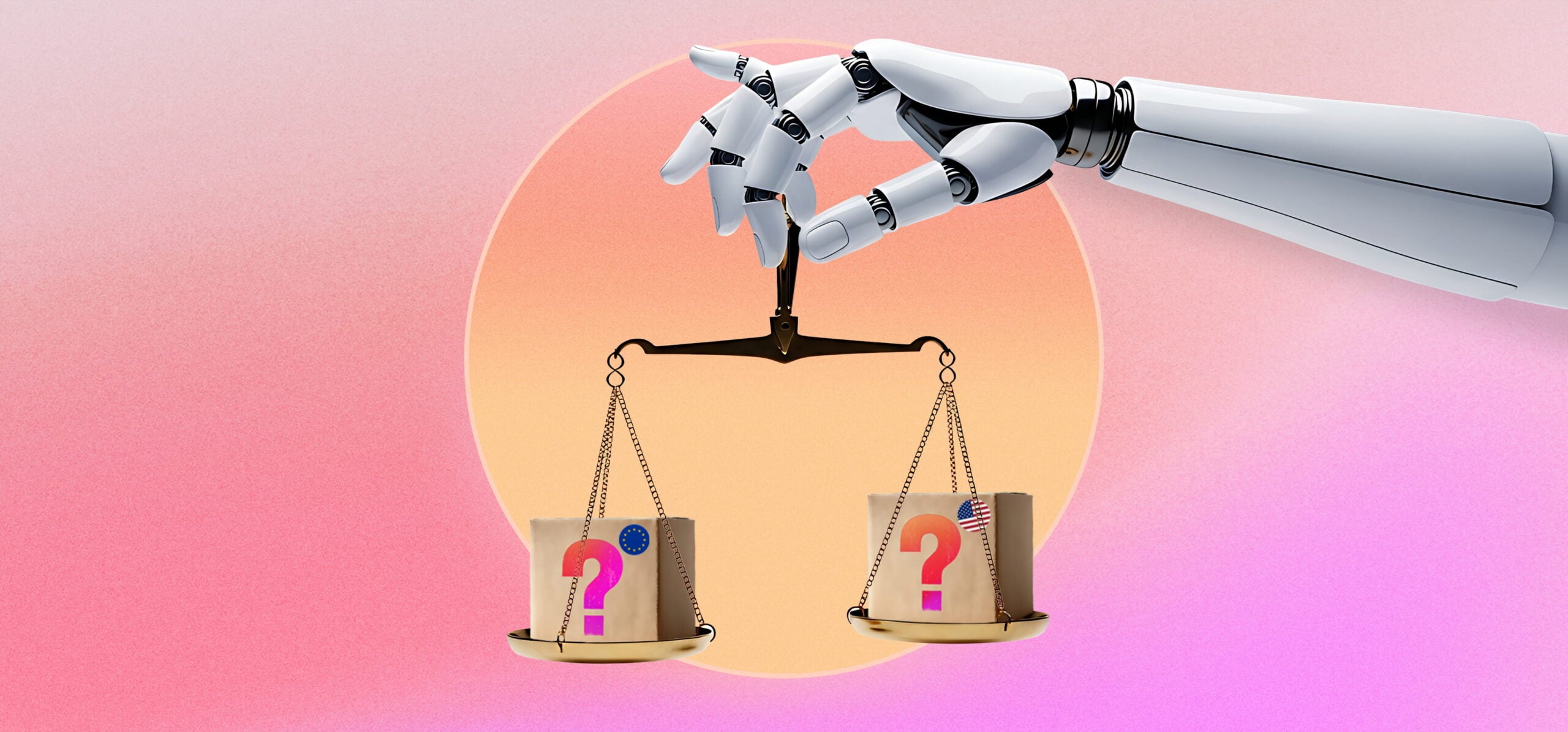
Yes, if your AI reaches EU customers. The EU AI Act doesn't apply to the UK as domestic law, but it applies directly to any UK business whose AI system is offered to people in the EU, or whose AI output is used there. The transparency rules that affect most everyday AI, including chatbots, apply from 2 August 2026.
This article is general information about the EU AI Act, not legal advice. Regulatory requirements vary by business and circumstance, consult qualified legal counsel before making compliance decisions for your organisation.
Key takeaways
- The EU AI Act applies directly to UK businesses whose AI reaches EU users or whose AI output is used in the EU
- Chatbot disclosure under Article 50 takes effect on 2 August 2026, and this date has held even as other parts of the Act face proposed delays
- Disclosure must be clear and upfront, not buried in policy documents or small print
- The UK has no equivalent AI Act and instead regulates AI through existing sector regulators
- Treating AI transparency as a trust feature, not just a compliance task, is good practice regardless of which law applies
What is the EU AI Act?
Definition: the EU AI Act is the world's first comprehensive law governing artificial intelligence. Rather than regulating the technology itself, it sorts uses of AI into risk tiers and applies heavier rules as the risk increases.
| Risk level | What it covers | What the law does |
|---|---|---|
| Unacceptable risk | Uses like government social scoring or manipulative systems that exploit vulnerable groups | Banned outright, in force since February 2025 |
| High risk | AI in areas like hiring, education, critical infrastructure and medical devices | Strict obligations before and after going to market |
| Limited / minimal risk | Most everyday AI, including chatbots and generative tools | Light transparency duties, or none |
Most UK businesses using everyday AI tools, such as a customer-facing chatbot, sit in the limited-risk tier, and it's this tier's transparency duties that arrive on 2 August 2026.
Why does an EU law affect a UK business after Brexit?
Brexit means the UK isn't bound by the EU AI Act as domestic law, but the Act reaches beyond the EU's borders in three ways.
- Direct reach: if a UK business offers an AI system to EU users, or its AI output is used in the EU, that business falls within the Act's scope regardless of where it's based. This mirrors the extraterritorial reach that caught many UK businesses off guard with GDPR.
- The "Brussels effect": global vendors and platforms tend to build one product to the EU's standard rather than a separate version for each market, so features built for EU compliance often roll out to UK customers too.
- Shifting expectations: once EU customers are routinely told when they're talking to a bot, UK customers start expecting the same, whether or not any UK law requires it.
When do the EU AI Act's transparency rules start?
The transparency rules, set out in Article 50 of the Act, apply from 2 August 2026. This includes the duty on chatbots and virtual assistants to identify themselves as AI. This date has remained fixed even as other parts of the Act have been subject to proposed delays (see the timing note further down this page).
What is Article 50 of the EU AI Act?
Definition: Article 50 is the section of the EU AI Act that sets transparency duties for AI systems that interact with people or generate content, even where that AI isn't classed as high risk. It applies to any business using AI in four specific situations, described below.
Do chatbots have to say they're AI?
Yes. Providers of chatbots, virtual assistants and automated phone systems must design them so users know they're interacting with AI rather than a person. For a UK business, this means reviewing every point where a customer might reasonably assume they're speaking to a human, and making sure the AI identifies itself clearly at the start of the interaction.
Does AI-generated content need to be labelled?
Yes. Text, images, audio and video produced by generative AI must be marked in a machine-readable format and be detectable as AI-generated. A standardised EU "AI" label is being developed for this purpose. Marketing copy, product images and social posts created with AI tools may soon carry this label by default.
Do deepfakes need to be disclosed?
Yes. Anyone using AI to create a deepfake, meaning synthetic image, audio or video that looks authentic, must disclose that it's artificially generated. There's a lighter-touch version of this duty for content that's evidently artistic, creative or satirical.
Does AI that reads emotion or biometric data need to tell people?
Yes. Systems that recognise emotion or categorise people by biometric traits must inform the individuals exposed to them. This sits alongside, not instead of, existing UK GDPR obligations.
These four duties apply to any AI system used in these situations, not only to systems formally labelled "high risk." A small UK business with no high-risk AI at all can still have real obligations under Article 50.
What counts as adequate AI disclosure?
Disclosure under Article 50 is a floor, not a ceiling, and a token gesture doesn't meet it. The notice has to be clear, easy to notice, and given at the start of the interaction, not buried where a customer would have to go looking for it.
| Real disclosure | Box-checking |
|---|---|
| “You’re chatting with our AI assistant” at the top of the conversation | A line about “automated systems” buried in the privacy policy |
| A clear, persistent “AI-generated” label on an image or video | A faint watermark you’d never notice |
| Told before the call or clip begins | Told after the fact, or not at all |
Is the EU AI Act timeline still changing?
Partly. EU institutions provisionally agreed a "Digital Omnibus" package in May 2026, which delays some of the more demanding high-risk obligations and gives a short transitional window for the content-marking duty specifically, covering generative systems already on the market before August 2026. That agreement was still provisional and pending formal publication at the time of writing.
The core chatbot disclosure duty under Article 50 has not moved: UK businesses should still plan around 2 August 2026 as the date their customer-facing AI needs to start identifying itself.
How does the UK regulate AI, if there's no UK AI Act?
Definition: as of mid-2026, there is no single UK AI Act, and none is currently before Parliament. Instead, the UK regulates AI through existing regulators applying existing law, a deliberate, principles-based choice rather than a gap awaiting legislation.
The main bodies involved are the ICO, on data protection and AI-driven decisions; the FCA, in financial services; Ofcom, in telecoms and online safety; and other sector regulators within their own remits. A UK business is effectively tracking two things in parallel: sector-led guidance building at home, and the EU's single, comprehensive rulebook next door, which applies the moment EU customers or EU outputs are involved.
What should a UK business do to prepare?
A sensible first pass, without needing to overhaul everything before August:
- Map where AI interacts with people or produces content, especially anything a customer sees or hears
- Check whether any of it reaches the EU. EU users, EU customers, or output used there can pull a UK business into scope
- Ask vendors what they're doing to prepare, and get their compliance commitments in writing
- Make AI introduce itself wherever a customer might otherwise assume they're speaking to a person, regardless of whether the law strictly requires it in that instance
- Treat transparency as a trust feature rather than a legal chore. Customers increasingly reward businesses that are upfront about how and where they use AI
Can an answering service help with AI transparency requirements?
Moneypenny's hybrid model is built around real people handling the conversations that need a human touch, with AI Receptionist working alongside them. Callers are told clearly how the two fit together, because transparency isn't a box to check, it's how the service is designed from the outset.
For a business rethinking how its calls get answered in light of this law, that kind of built-in clarity about who, or what, a customer is speaking to removes much of the guesswork around Article 50 compliance for phone-based AI.
The EU AI Act doesn't apply to the UK as domestic law, but it applies directly to any UK business whose AI reaches EU customers, and its influence is likely to shape customer expectations more broadly. The chatbot disclosure duty takes effect on 2 August 2026. Meanwhile, the UK continues to regulate AI through existing sector regulators rather than a single AI law of its own.
Related reading: for more on how AI and human receptionists work together, see AI Receptionist: The Complete Guide for UK Businesses.
See how our hybrid human and AI approach keeps you transparent with every caller
Callers always know who, or what, they're speaking to, by design, not as an afterthought.
Sources
- European Parliament, "EU AI Act: first regulation on artificial intelligence".
- European Commission, "Shaping Europe's Digital Future: AI Act".
- Future of Life Institute, "A Practical Guide to Article 50".
- Information Commissioner's Office, guidance on AI and data protection.
Frequently asked questions
- Does Brexit mean the EU AI Act doesn't apply to UK businesses?
Not entirely. Brexit means the Act isn't part of UK domestic law, but it still applies directly to a UK business if it offers an AI system to EU users or its AI output is used in the EU. Domicile doesn't determine scope, where the AI is used does
- Is there a UK equivalent to the EU AI Act?
No. As of mid-2026, there's no single UK AI Act and none is before Parliament. The UK regulates AI through existing regulators, including the ICO, FCA and Ofcom, applying existing law within their own sectors, rather than one horizontal AI statute.
- What happens if a business doesn't comply with Article 50?
Under the EU AI Act, non-compliance with transparency obligations can carry significant fines, enforced by national market surveillance authorities in EU member states. For a UK business in scope, the practical risk is enforcement wherever its AI reaches EU users or EU-based output.
- Which UK regulators oversee AI in the absence of a UK AI Act?
The ICO covers AI touching personal data, the FCA covers AI in financial services, and Ofcom covers AI in telecoms and online safety, each applying their existing powers rather than a dedicated AI law. Other sector regulators apply their own rules to AI within their specific remits.
- Do UK-only businesses with no EU customers need to worry about the EU AI Act?
Less directly. If an AI system never reaches EU users and its output is never used in the EU, the Act's direct legal reach is limited. Even so, disclosure practices are increasingly expected by customers generally, so many UK businesses choose to adopt clear AI disclosure as good practice regardless.





Get your quote from the UK’s #1 provider today
Provide us with a few details and we’ll contact you to explain how Telephone Answering will work for your business. Alternatively, call 0333 202 1005 to find out more.
What to expect:
- Thousands of businesses on board
- Unmatched sector expertise
- Award-winning culture